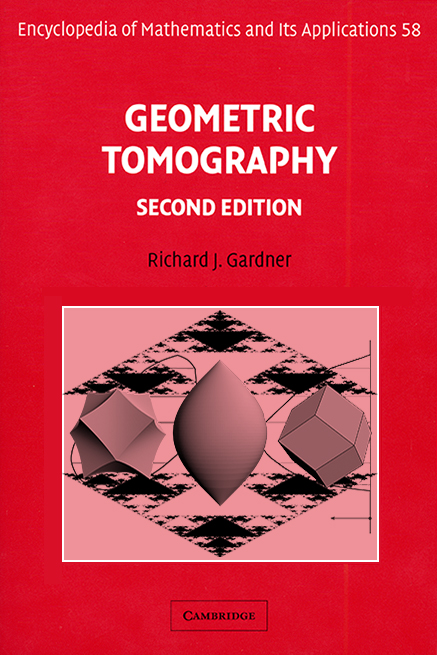
In recent years my research has been in a new field called Geometric Tomography, an area of mathematics dealing with the retrieval of information about a geometric object from data concerning its projections ("shadows") on planes and/or sections by planes. The subject has connections with convex geometry, stereology, geometric probing in robotics, computerized tomography, and other areas. The second edition of my 1995 book "Geometric Tomography" was published by Cambridge University Press (New York) in June 2006, and is available here in paperback, hardback, or as an e-book. It is designed to be somewhat accessible even to advanced undergraduate students, and contains 79 computer-generated pictures, 66 open problems, and 872 references.
UPDATE to the second edition, version 3.0. (Changes since the previous version 2.1 are highlighted here. These are very substantial, due to the AI invasion.) This file contains a list of corrections and reports on the current status of the open problems stated at the end of each chapter. The latter include the notorious slicing problem (or hyperplane conjecture, Problem 8.3) (confirmed in 2024 and the even stronger thin shell conjecture confirmed in 2025!) and Mahler's conjecture (Problem 9.2).
See below for pdf files containing tentative solutions, produced by AI from prompts by the author, of some of the problems stated in the book.
My research on geometric tomography has been supported by the National Science Foundation under grants number DMS-9201508, DMS-9501289, DMS-9802388, DMS-0203527, DMS-0603307, DMS-1103612, and DMS-1402929. Any opinions, findings, and conclusions or recommendations expressed in this material are those of the author and do not necessarily reflect the views of the National Science Foundation.
See the main page for geometric tomography for a quite comprehensive introduction to the subject, with examples, theory, and some working algorithms.
There is a rudimentary Wikipedia page for Geometric Tomography (not written by me!).
Workshop on Geometric Tomography and Harmonic Analysis, Banff International Research Station, Canada, March 9 to 14, 2014.
Workshop on Discrete and Geometric Tomography, and Applications to Computer Algorithms, Politecnico di Milano, Italy, April 22 and 23, 2010.
Second Summer School on Stereology and Geometric Tomography, Sandbjerg Estate, Denmark, June 17 to 21, 2002.
First Summer School on Local Stereology and Geometric Tomography, Sandbjerg Estate, Denmark, May 20 to 25, 2000.
Another Geometric Tomography web page with a nice animation of 3-dimensional sections of a 4-dimensional cube.
Discrete Tomography is a related area with a life of its own.
There is a large overlap between geometric tomography and convex geometry. Some nice photos, including a group photo of the convex geometry community as it was fifteen years ago, can be found via the following link.
Workshop on Geometric Inequalities, Florence, Italy, May 16 to 20, 2005.
Some auxiliary material for published papers:

 An early version of my paper
The Brunn-Minkowski inequality, Bull. Amer. Math. Soc.
39 (2002), 355-405 that contains several full proofs.
The proof of estimate (7) in
R. J. Gardner and Peyman Milanfar, Reconstruction of convex bodies from brightness functions, Discrete Comput. Geom.
29 (2003), 279-303.
An early version of my paper
The Brunn-Minkowski inequality, Bull. Amer. Math. Soc.
39 (2002), 355-405 that contains several full proofs.
The proof of estimate (7) in
R. J. Gardner and Peyman Milanfar, Reconstruction of convex bodies from brightness functions, Discrete Comput. Geom.
29 (2003), 279-303.
An extended version of:
R. J. Gardner, Markus Kiderlen, and Peyman Milanfar, Convergence of algorithms for reconstructing convex bodies and directional measures, Ann. Statist. 34 (2006), 1331-1374.
Papers recently published:
R. J. Gardner, Washek Pfeffer (obituary), Real Anal. Exchange 46 (2021), 269-278.
Gabriele Bianchi, R. J. Gardner, and Paolo Gronchi,
Full rotational symmetry from reflections or rotational symmetries in finitely many subspaces, Indiana Univ. Math. J. 71 (2022), 767-784.
Gabriele Bianchi, R. J. Gardner, and Paolo Gronchi,
Convergence of symmetrization processes, Indiana Univ. Math. J. 71 (2022), 785-817.
Walter R. Bloom, R. J. Gardner, Al Hales, Joel Spencer, Terence Tao, and Benjamin Weiss,
Robert Israel "Bob" Jewett (1937-2022) (obituary), Notices Amer. Math. Soc. 70 (2023), 772-781.
Gabriele Bianchi, R. J. Gardner, Paolo Gronchi, and Markus Kiderlen,
The Pólya-Szegö inequality for smoothing rearrangements, J. Funct. Anal. 287 (2024), Paper No. 110442, 56 pp.
Preprints:
Gabriele Bianchi, R. J. Gardner, Paolo Gronchi, and Markus Kiderlen,
Approximation of rearrangements by polariations, Nonlinear Anal., to appear. Also available on arXiv:2509.02162.
Drafts generated by AI:
Verification, successive determination, and determination of ellipsoids by k-dimensional X-rays, a tentative solution of Problem 2.12 in my book produced by ChatGPT Plus on September 13, 2026. My intention is to check it by hand, produce a polished version, and perhaps post it on arXiv. I do not and will not claim any credit for the solution.
Convex bodies of constant i-girth without constant i-brightness, a tentative solution of a 1970 problem of Firey produced by ChatGPT Plus on August 30, 2026. This old question is Problem 3.7 in my book. A check by ChatGPT Pro suggested some minor changes, but otherwise confirmed the result. My intention is to check it by hand, produce a polished version, and perhaps post it on arXiv. I do not and will not claim any credit for the solution.
Affinely equivalent central sections of star bodies, a tentative affirmative answer to Problem 7.4 in my book, produced by ChatGPT Plus on September 10, 2026. (In the special case of origin-symmetric convex bodies, this is an old question attributed to Banach, to which an AI-assisted solution was recently posted by Lu and Yang.) It has not yet been checked by hand. I do not and will not claim any credit for the solution.
Generalized intersection bodies and radial sums, a tentative solution of Problem 8.5 in my book produced by ChatGPT Plus on August 30, 2026 (and since modified slightly). My intention is to check it by hand, produce a polished version, and perhaps post it on arXiv. I do not and will not claim any credit for the solution.
A counterexample for an infinite set of divergent-beam sources, a tentative negative answer to Problem C.1 in my book produced by ChatGPT Plus on September 10, 2026. It has not been independently checked. I do not and will not claim any credit for the solution.
PDF files for published versions of most of my earlier papers are available on request. To see a full list of publications, consult my curriculum vitae or the excellent
MathSciNet search engine, where reviews and citations
can also be found. Here is a link to my Google Scholar
page.